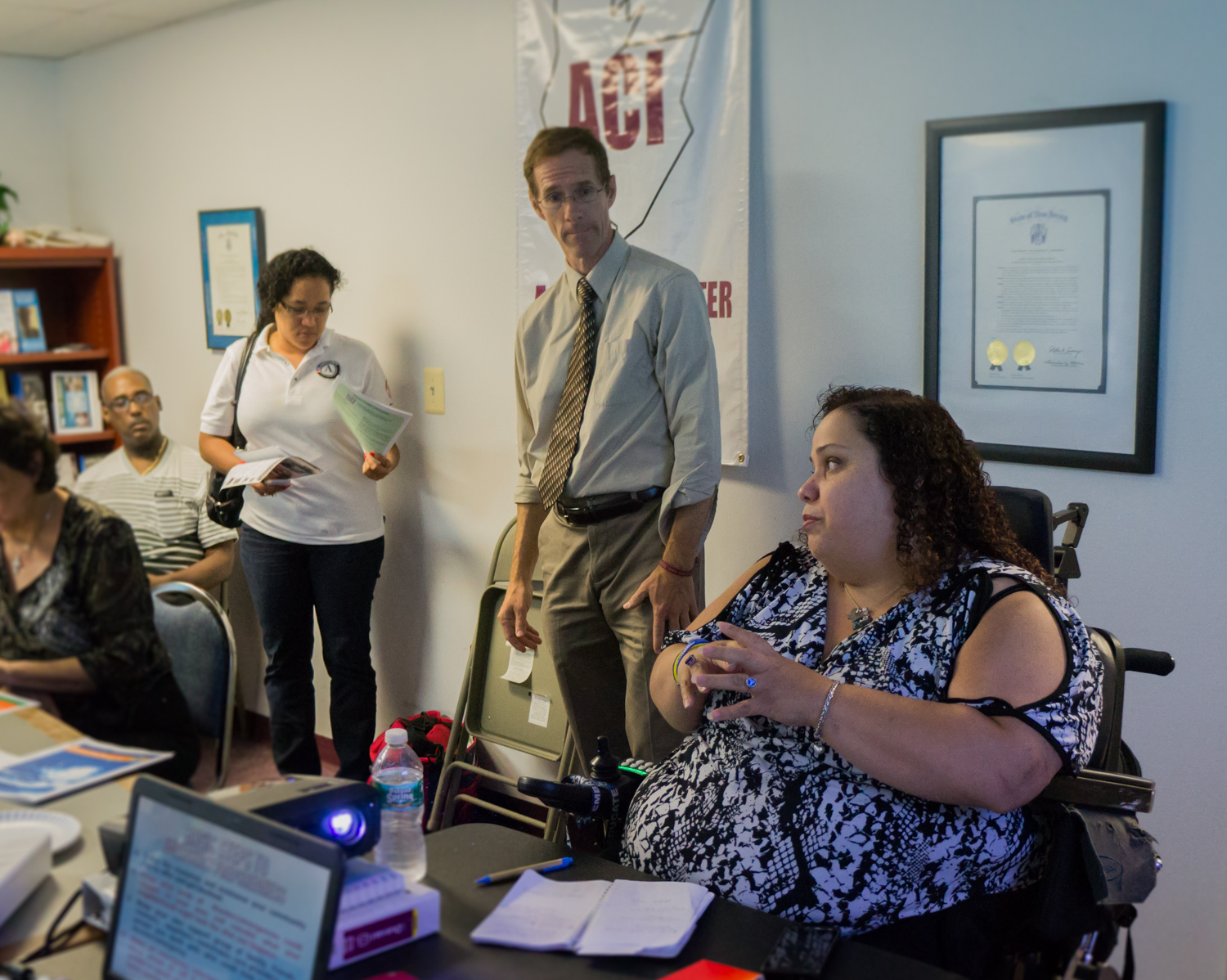
Photo source: Post-Gazette
Do you live, work or travel in Middlesex County, NJ? Please take a moment to fill out this important survey. Thanks!
 Alliance Center for Independence

Photo source: Post-Gazette
Do you live, work or travel in Middlesex County, NJ? Please take a moment to fill out this important survey. Thanks!

Are you a person with a disability affected by Super Storm Sandy?
Need to replace your wheelchair or other durable medical equipment?
Need a ramp or platform lift?
Portlight Strategies may be able to help!
Please visit portlight.org or contact Susan Pniewski at 732-319-7830 or sue@portlight.org for more information.
Funded through grants from The Sandy Relief Fund and Robin Hood Foundation.

ACI is partnering with the Middlesex County Emergency Food Network (M.C.F.O.O.D.S.) to collect non-perishable food items, such as canned fruits and vegetables, as well as household products such as diapers, soap, toothpaste, and razors. Your donations will help areas residents, including those with disabilities, who are food insecure.
Please drop off all food items at the ACI office at 629 Amboy Ave, Edison, NJ 08837.

For more information, contact Luke Koppisch at lkoppisch@adacil.org or 732-738-4388 ext 110.

The New Jersey State Library Talking Book & Braille Center (TBBC) is a public library for New Jersey residents whose ability to read is affected by a physical impairment, a reading disability, or a vision impairment. Anyone who cannot read standard print or who as difficulty holding a book or turning the pages of a book may qualify to receive books in Braille, cassette, and digital formats.
Complete an application and have it certified for eligibility. To obtain an application, call toll-free at 1-800-792-8322 or download an application from the TBBC website.
For more information, please visit njsltbbc.org or email tbbc@njstatelib.org.
Over 20 people attended an ACI sponsored workshop on emergency preparedness for people with disabilities on Tuesday, August 13th. This event was one of a series of emergency preparedness workshops that ACI has been conducting throughout the Summer under a grant from AmeriCares Hurricane Sandy Relief Program.
Thank you to presenter Millie Gonzales, ACI Board of Trustee members, who shared her experiences of being displaced by the storm and tips on preparing for the next disaster.
A message from nj.com

Star-Ledger file photo
People with disabilities will now be required to have their medical conditions recertified every three years to qualify for parking privileges in New Jersey, Motor Vehicle Commission chief administrator Raymond Martinez said today.
In the past, motorists would be required to undergo only an initial medical classification to qualify for the special placard and license plate. After that, materials would be renewed by mail every three years.
Now, when renewal is up, so is a medical classification requirement by a qualified medical professional. The changes take effect Aug. 1.
Motorists who already have the placards will not need to submit recertification until they're due for renewal.
The placards that are hung on rearview mirrors will also be redesigned to make the expiration date more visible and to prevent alterations. License plates that are renewed every year are also subject to the three-year medical recertification.
Martinez said the new rules aim to reduce fraud associated with the program. He said law enforcement officers often find motorists who use placards that are not assigned to the vehicle they are using or the placards belong to someone who has died.
Mainly, the new laws aim to reduce the number of placards and license plates issued to people who are no longer qualified to have them.
"It was almost an automatic renewal," Martinez said of the previous process. There was "no certification process with teeth to it, with scrutiny."
There are more than half a million placard and license plate holders in the state.
The MVC has already begun mailing registration renewals explaining the new law.
"This is just an attempt to tighten up the process a little bit," Martinez said. "Those spots are not just there for convenience, they're out of necessity."
SOURCE: nj.com via Associated Press
A message from the Mental Health Association in New Jersey

On August 7, New Jersey made important progress in our efforts to end stigma when Governor Christie signed A3357/S2224 into New Jersey law. The passing of this law will result in the removal of negative terms referring to people with psychiatric, cognitive or developmental disabilities in state statutes. The bills were sponsored by Assemblywoman Valerie Vainieri Huttle and Senate Majority Leader Loretta Weinberg with many co-sponsors. It is important to note that the bill passed through both the New Jersey Senate and Assembly with unanimous positive votes in both houses!
Mental illness can strike anyone. It knows no age limits, economic status, race, creed or color. During the course of a year, one in four families is affected by mental illness. Many people have wrong and damaging ideas on the subject. Their opinions affect their actions and often prevent New Jersey residents with mental illness from living productive lives and contributing to their communities. Stigma around mental illness is often a huge obstacle to individual recovery. Accurate facts and information may help change negative ideas and help develop more informed and fair opinions.
"The Mental Health Association in New Jersey applauds our legislators for recognizing the importance of language in the fight against stigma," stated Carolyn Beauchamp, President and CEO of the Mental Health Association in New Jersey (MHANJ).
"Opinions are often formed by what is said, words that are used to describe mental illness or those with a mental illness. Changing outdated, disparaging language in our laws makes a strong statement that in New Jersey we are taking responsibility at the highest levels to acknowledge and remove destructive words that have contributed to stigma against those suffering with a mental illness," said Senator Weinberg.
"This is an important step in helping to change opinions about mental illness that are negative and based on incorrect information. These views cause stigma which often inhibits people who have mental illness from seeking treatment due to fear of repercussions of public knowledge of their problem. The treatment they avoid could be the key to enable them to lead productive lives and contribute to their communities," stated Assemblywoman Huttle.
Ultimately, this law eliminates demeaning and disrespectful terms when referring to persons with psychiatric, cognitive or developmental disabilities. For example: first-person language is now used; provisions are made gender neutral to the extent possible; anachronistic and unclear language has been eliminated or refined; and the names of institutions and agencies have been made current.
Examples of language to be replaced include:
The MHANJ, Disability Rights New Jersey and other community partners consulted with the New Jersey Law Revision Commission as the bill was designed and developed. The MHANJ in a leadership role, along with the New Jersey Mental Health Coalition and others in the mental health community were strong advocates in supporting the bill.
SOURCE: MHANJ's Cutting Edge Newsletter